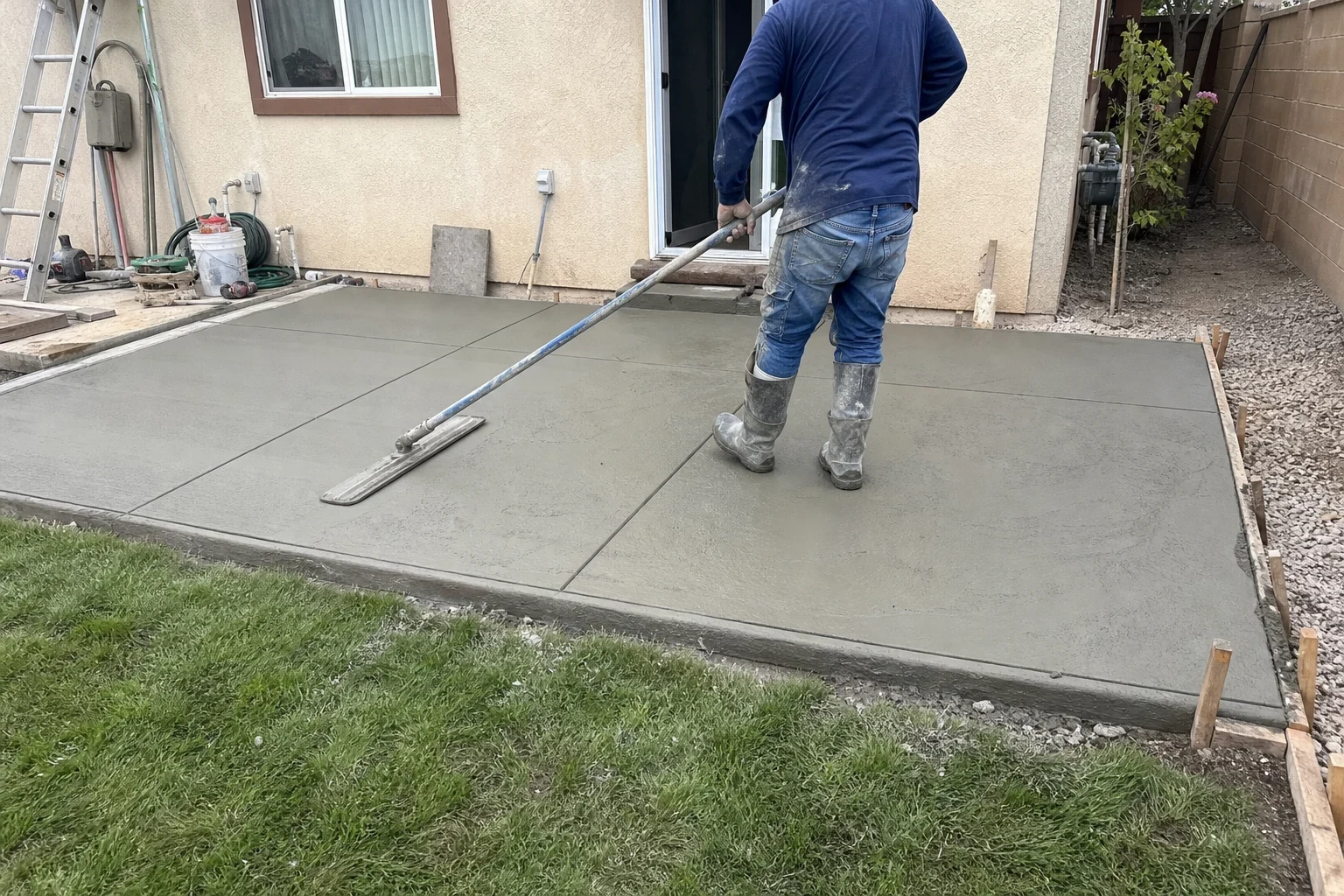
ServicesPatios
Concrete Patios in Orange
We plan and pour concrete patios that fit the way you use your backyard, from a simple slab off the back door to a larger space for dining and shade. One person handles your questions and keeps the job on track from the first visit to the final sweep.
A patio that works for your yard, not just a slab
A good patio starts with the parts you never see. The ground has to be graded and compacted, the base has to be the right depth, and the surface needs a gentle slope so water runs away from your home instead of toward the slider. Get those right and the finish on top is what you enjoy for decades.
Many yards around Orange sit on clay soil that swells when wet and shrinks in the dry months. We account for that with proper base material, reinforcement and control joints placed where cracks would want to form, so movement stays hidden in a joint line instead of running across the middle of your patio.
You deal with one person the whole way. The same contact who measures your yard explains the estimate, schedules the pour and walks the finished patio with you. No passing messages between an office, a salesperson and a crew.
What your patio project includes
Layout and measuring
We mark the patio shape on the ground with paint or string so you can stand in it, picture the table and chairs, and adjust before anything is dug.
Removal of the old surface
If there is an old patio, worn pavers or lawn in the way, we break it out and haul it off. You are not left with a pile of debris by the side yard.
Grading and base
We excavate to the right depth, compact the soil and add a gravel base. The finished grade is set to fall away from your home's foundation.
Forms and reinforcement
Wood or steel forms set the edges and height. Rebar or wire mesh goes in on chairs so it sits inside the slab where it actually does its job.
Pour and finish
Choose a broom finish for grip, a smooth trowel border, exposed aggregate, or a pattern from our stamped concrete work. Control joints are tooled or cut at planned spacing.
Cleanup and walkthrough
Forms come out, the edges are backfilled and the area is cleaned. We go over curing and care with you before we leave.
Signs it may be time for a new patio
- Water pools near the house
- If puddles sit against the back wall or seep under the door after rain, the old slab is likely sloped the wrong way. A new patio can be graded to send water out to the yard.
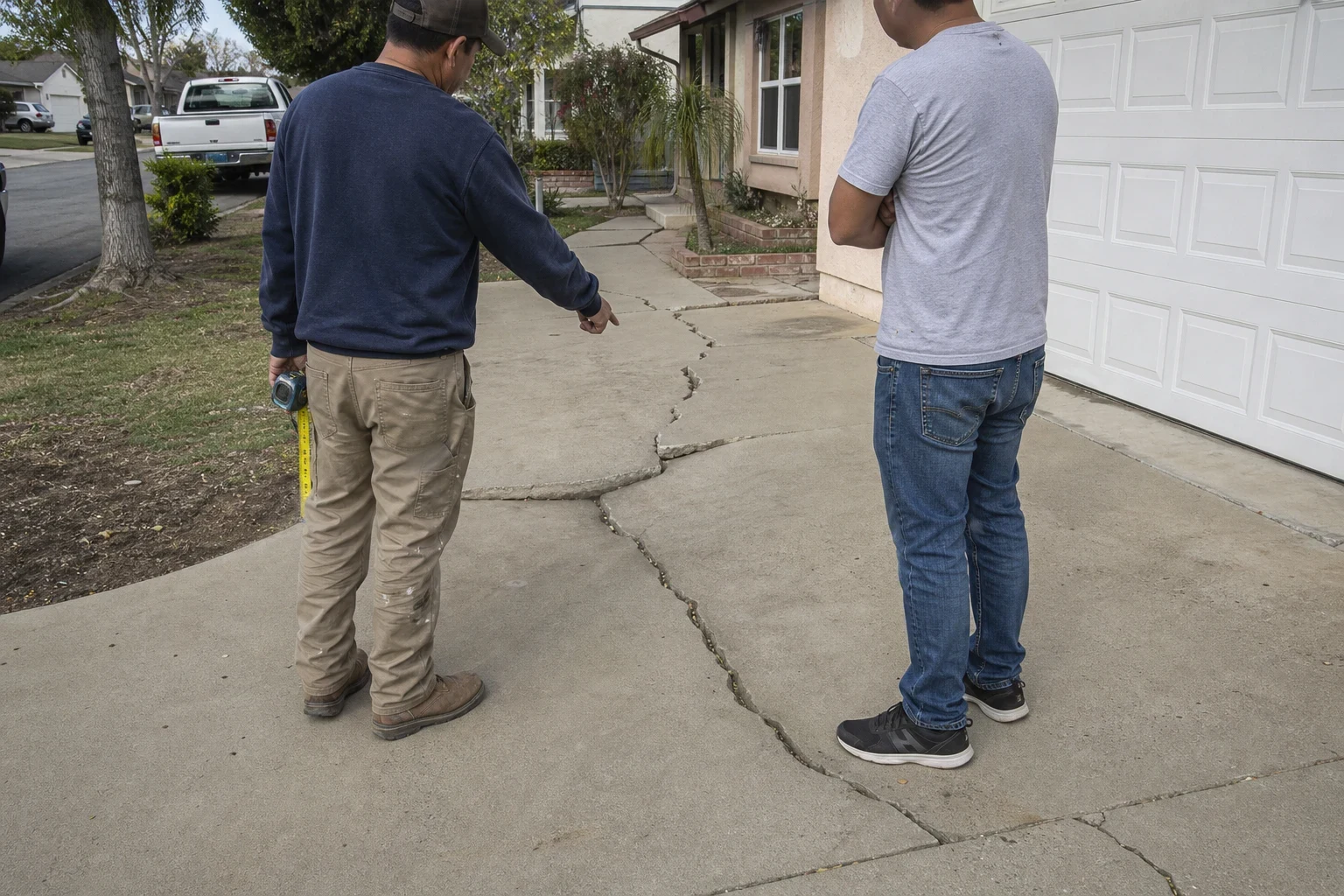
- Wide cracks and uneven sections
- Slabs that have split and settled into different heights become trip hazards. When the damage runs across most of the surface, replacing it is usually the cleaner answer.
- Pavers shifting and sprouting weeds
- Loose pavers that rock underfoot and fill with weeds every spring take constant upkeep. A poured patio gives you one solid surface.
- The space is too small to use
- A narrow strip outside the back door rarely fits a dining set. If you keep wishing for more room, it may be time to pour the patio you actually want.
- Bare dirt or tired lawn out back
- A patch that turns to dust in summer and mud in winter is a common starting point. Concrete turns it into usable space with far less maintenance.
How your patio gets built
- 1
Visit and estimate
Your contact comes out, measures the space, looks at drainage and access, and goes over finish options with you. The estimate comes to you in writing, broken out item by item so nothing is lumped together.
- 2
Prep day
The crew removes the old surface, digs to depth, compacts the soil and places the gravel base. Forms and reinforcement go in, and we confirm the slope before any concrete arrives.
- 3
Pour day
Concrete is placed, leveled and finished while it is workable. On hot days we plan an early start so the surface does not dry out before it is finished properly.
- 4
Curing and cleanup
Joints are cut, forms are stripped and the site is cleaned. Your contact walks the patio with you and explains when you can use it.
What affects the cost of a patio
Every patio is priced from its own measurements and conditions. Your written estimate breaks the job into parts so you can see where the money goes and adjust the size or finish if you want to.
- Size and shape
- Square footage drives material and labor. Curves and angled corners take more forming time than a simple rectangle.
- Access to the backyard
- If a truck can reach the pour area, concrete goes in directly. A narrow side yard may mean wheelbarrows or a pump, which adds time and equipment.
- Removal and soil prep
- Breaking out an old slab, hauling it away or correcting poor soil and grading adds to the prep work.
- Finish choice
- A broom finish is the most straightforward. Exposed aggregate, colored concrete or stamped patterns add material and finishing labor.
- Extras built into the slab
- Thickened edges for a future patio cover, steps down to the lawn or sleeves for lighting wires are easier and cheaper to plan now than to add later.
Patio questions we hear often
- How soon can we use the new patio?
- You can usually walk across it within 24 to 48 hours. Give it around seven days before you bring out the grill or heavier furniture. The concrete keeps getting stronger for about a month, so try not to drag anything heavy over it during that stretch.
- Can you pour a new patio over our old one?
- Sometimes, but we usually recommend removing it. Pouring on top raises the height, which can bring the surface up to your door threshold and carry the old cracks and slope problems into the new slab. We will tell you honestly what we see at the estimate.
- Will my patio crack?
- Concrete shrinks as it cures, and small hairline cracks can happen. We place control joints so most of that movement happens along a straight line where you will not notice it. A solid base and proper reinforcement keep larger cracks from forming.
- Do we need to be home on pour day?
- Not necessarily. We need access to the backyard and a clear path for equipment. Your contact will confirm the schedule with you ahead of time and call when the work is done.
- Can the patio connect to a walkway or pool deck?
- Yes. Many people pair a patio with walkways and sidewalks along the side of the house or a concrete pool deck. Planning them together keeps the heights, slopes and finishes matched.
Let's plan your backyard patio
Tell us how you want to use the space and what is out there now. One person will take it from your first call through cleanup.